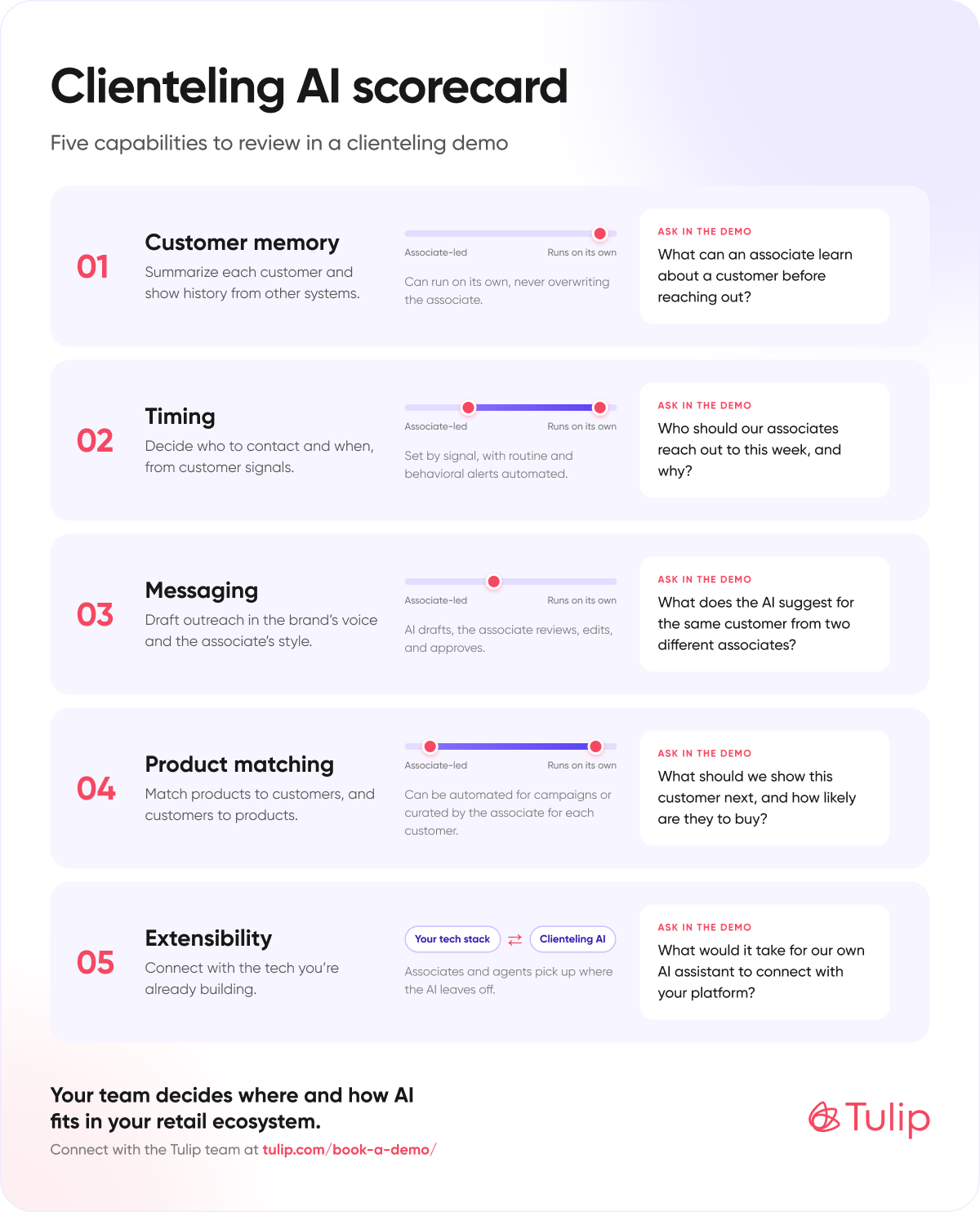
Every clienteling platform on your shortlist can demo clienteling AI, and those demos look alike until you ask two things: what advantage the AI gives the associate, and how much it can do before the associate steps in. If AI-powered clienteling doesn’t help amplify moments of human connection, is it truly clienteling?
Retailers decide what clienteling AI takes on
The work AI takes on is the retailer’s call. Clienteling AI earns its place when it takes on work that drives growth: a follow-up that would otherwise wait, the customer no one has time to reach, the product that never found its buyer. The more personal the work, the closer the associate should stay to it.
Some work makes sense to hand over to AI completely, a post-purchase thank you for example. The balance to strike is with trust, and that balance will keep moving as agentic clienteling makes it possible to hand more work to AI.
Ask in the demo: Who decides what the AI takes on, and how easily can that expand?
An extended memory for each customer interaction
Most associates know their top customers by heart, and the rest blur together. The first job of AI in a clienteling platform is to remember all of them, and adapt as customers change. Think of it as an extended memory for each customer interaction. With AI to assist, context can be pulled from what the associate knows about the customer and data the retailer is tracking. With Tulip AI, that memory enables capabilities like dynamic customer summaries, preferences that auto-update, product matching, and personal lookbooks.
Ask in the demo: Pull up one of your best customers. What would an associate know about them before reaching out, and what happens when the associate knows something the data doesn’t?
Finding the customers worth reaching out to
Customers managed through clienteling spend 63% more per month, but proactive customer outreach is the work that gets skipped when things get busy. The customer no one has time to reach out to can easily become the one who stops coming in.
Tulip AI identifies which customers are worth reaching out to based on signals like time since the last purchase, an upcoming milestone, or a wishlist item back in stock. With AI to do the prep, the associate is equipped to deliver meaningful outreach and a more personal sales experience.
Ask in the demo: Show me who our associates should reach out to this week, and why each name is on the list.
For the follow-up that would otherwise wait
Messaging is a known use case for clienteling AI. Rather than start from a blank screen, AI can pull customer context, apply the brand voice, and draft a message the associate can review, revise, and send in minutes. Without it, follow-up outreach relies on instinct not every associate may have. Tulip Messaging AI is trained on your brand voice and adapts to each user’s style, so every message fits the customer receiving it and the person sending it. Every AI-draft creates a complete audit trail, ensuring the record is reviewable and traceable, so AI-suggested messages can be governed by the retailer.
Ask in the demo: Have the AI draft a message to one of our top customers. Now show me what it suggests for two different associates.
Helping every product find its buyer
Every season ends with products that never reach the customer. Tulip AI can start with the product and find the customers most likely to buy, or start with the customer and match them to products that fit their preferences. Having product recommendations served from both directions helps retailers find their buyers faster for launches, inventory clearance, and end of season sales. And the personalized matches can inspire campaigns for both clienteling and corporate marketing.
Ask in the demo: Pick a customer and tell us what items we should show them next. How likely are they to buy?
Clienteling AI that works with the tech you’re already building
Many retailers are building AI of their own, from shopping assistants to models trained on their own customer data, and as agentic AI in retail matures, we expect more shoppers to arrive through AI agents. McKinsey estimates agentic commerce could orchestrate up to $1 trillion in US retail revenue by 2030.
Modern clienteling platforms like Tulip fit into that work, with integrations that connect your retail ecosystem without rebuilding it. When a shopper’s conversation with AI reaches the point where a person should step in, the associate should be able to pick up where AI left off. What the shopper asked for and what they ruled out, then, the associate can leverage the capabilities of clienteling AI to summarize the customer’s history with the brand.
Ask in the demo: What would it take for our own AI assistant to connect with your clienteling platform?
Your team decides where and how AI fits in your retail ecosystem. Reach out to our team for a demo of Tulip AI, and use the clienteling AI scorecard below to evaluate the clienteling platforms on your shortlist.